
 On screen
A boutique studio rarely has a general awareness problem. It has a calendar problem: the 6 a.m. class that runs half empty, the new format that needs a first cohort, the July dip when regulars travel. Advertising works better when it is pointed at one of those problems instead of at the studio as a whole.
This playbook is written from the studio owner's side. It covers how to plan digital out-of-home (DOOH) advertising, meaning video ads on screens in places people already visit, to fill specific classes. If you are planning the January membership push instead, see new year membership campaigns for gyms.
Start with the class you need to fill
Before you pick a venue or write a line of copy, write down the problem in one sentence. A useful version names a class, a day and a time, and a rough sense of how many open spots you would like to fill.
| Problem | Who to reach | What the ad needs to do |
|---|---|---|
| Early-morning class runs half empty | People near the studio with flexible or early schedules | Name the time and make the first visit feel low-risk |
| Midday class has open spots | Remote workers, shift workers, people running errands nearby | Show that the class fits into a lunch break or a gap in the day |
| New format needs a first cohort | Nearby people who already exercise or have thought about it | Explain the format in one visual and invite a first class |
| Summer slump | Lapsed members and nearby newcomers | Offer a reason to come back or try something new before the September return to routine |
Pick one row for your first campaign. A campaign trying to fix all four at once usually ends up saying nothing specific.
Where your audience waits
In general, people with flexible schedules turn up in coffee shops, salons, offices and wellness waiting areas, and weekday mornings and early evenings are when fitness intentions tend to be on people's minds. That is a general observation about daily life, not a statement about specific CETV Now locations.
CETV Now runs in high-dwell commercial venue categories: auto dealerships, restaurants and bars, medical and dental offices, fitness and wellness facilities, retail, and professional services such as offices and salons. CETV Now reports average dwell time of 15+ minutes across its network, based on its own network data that is not third-party audited. Dwell time describes how long people are in a venue. It does not measure how closely they watch.
For a boutique studio, the categories that most often make sense to test are:
- Professional services such as salons and offices, where people sit and wait on predictable schedules.
- Restaurants and bars, useful for early-evening and weekend invitations, such as a Saturday class.
- Fitness and wellness facilities, where the audience already exercises. Check how this fits with your own category and how placements are curated.
- Retail, if the studio sits near a shopping area and you want the neighborhood around it.
Which specific venues are available in your area depends on the market. Named venue partners are not published, so ask for the plan when you request a quote.
Target by neighborhood and time of day
A studio draws from a small radius, so wide reach is mostly wasted. CETV Now targeting works by neighborhood, city, metro, zip code, sector or vertical, and individual venue, and it can be layered with audience type and daypart (time of day).
In practice, that means you can match the ad to the class. A 6 a.m. class invitation might run in the zip codes around the studio during the evening before, when people are planning tomorrow. A lunchtime class might run on weekday late mornings. These are planning ideas to test, not predictions of what will work.
What to say in the ad
On a venue screen, people glance for a few seconds, often without sound. The ad has to make sense quickly. For class-fill campaigns, a few principles hold up.
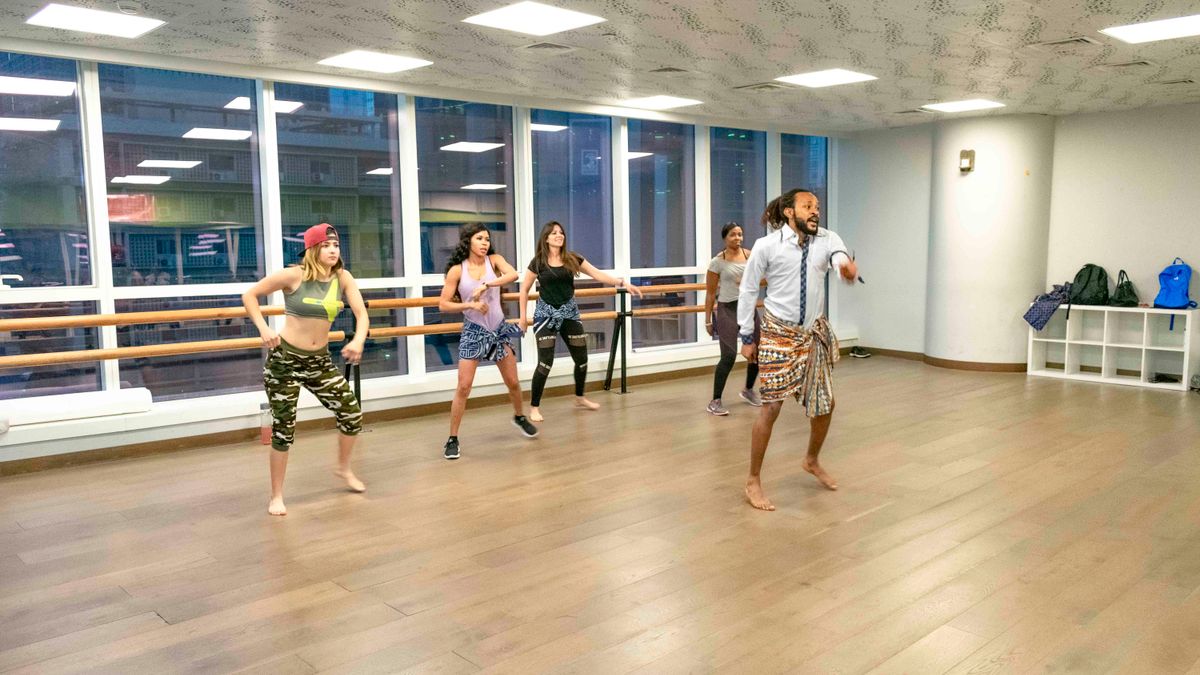
- Show the class and the instructor, not the equipment. People decide whether they would feel comfortable in the room. A face and a moment of the class says more than a rack of machines.
- Name the time that needs filling. "Tuesday and Thursday, 6:15 a.m." is more useful than "classes all week."
- Make one offer. A first-class trial, an intro pack or a bring-a-friend invitation. Pick one so the ask is clear.
- Keep the next step simple. The studio name, the neighborhood, and one way to book. If you use a QR code, read when QR codes help on venue screens first.
- Design for sound off. Use on-screen text for the time and the offer. See how to make video ads work without sound.
For help with the offer itself, how to design a local offer ad goes through the structure in more detail.
Choose the format for the job
CETV Now supports full-screen video, static creative, multi-spot branded campaigns and local offers. Full-screen video runs as an unskippable takeover of the venue's live TV, and creative can be a 30-second video, static designs, or animated motion graphics shown as overlays on live TV. Details are on the ad formats page.
| Task | Format to consider | Why |
|---|---|---|
| Introduce a new class format | 30-second full-screen video | Room to show the instructor and the class in motion |
| Announce a schedule change or added class | Animated overlay on live TV | Short, text-led and easy to update |
| Promote a trial or bring-a-friend offer | Local offer creative | Keeps the offer and the time in one frame |
| Run a multi-week new-class launch | Multi-spot branded campaign | Several messages across the launch period |
Creative is submitted for review before it runs, and placements run in curated venue categories to keep brands in appropriate contexts. CETV Now has not published creative specifications or review timing here, so ask the team before you commission video.
Plan around the studio calendar
Fitness demand follows the calendar, and studios can plan ahead of it. This is seasonality, and three moments matter for class fill.
New class launches
A new format needs a first cohort. Start the invitation before the first session, use the trial or a founding-member style offer, and keep the message focused on one class time. The structure is similar to a grand opening campaign, just at the scale of a single class.
The summer slump
Summer often brings travel and schedule changes. Rather than pushing general membership, consider promoting a specific time slot with a low-commitment offer, or a bring-a-friend invitation that gives regulars a reason to show up. Then use the late summer to invite people to start a routine before September.
The September return to routine
Schedules settle in the fall, and people look for new habits. It is a natural point to refill the early-morning and midday classes that thinned out. For the longer annual view, see the January advertising calendar, which covers planning ahead for the new year.
Start small and read the results
Ad insertion has no minimums and no long-term commitment. You set your spend and schedule and scale at your own pace. Pricing is quote-based and depends on market, venue category and schedule, so there is no published rate card.
A sensible first test is one class, one offer, a few nearby zip codes and a defined window. Delivery is tracked and reported against CETV Now network data, with venue-level impression reporting and real-time statistics. Impressions show delivery, not bookings, so keep your own tally. Ask new bookers how they heard about you, use a dedicated offer code or trial page, and compare class attendance to the weeks before. Attribution is rarely perfect for in-person businesses, so look at several signals together.
CETV Now reports a 4.2x average campaign ROI and 98% viewer recall across its network. These are CETV Now reported figures, not third-party audited, individual results vary, and no outcome is guaranteed. Treat them as context, not a forecast for your studio.
A short planning checklist
- 01
Name the class problem
Pick one class, day and time, or one new format, and write the goal in a sentence.
- 02
Define the radius
List the neighborhoods or zip codes your members realistically travel from.
- 03
Pick venue categories and dayparts
Choose from the approved categories and match the daypart to the class time.
- 04
Write one offer
A trial, intro pack or bring-a-friend invite, with the time and studio name on screen.
- 05
Prepare a measurement plan
Decide how you will track bookings: offer code, intake question, or attendance comparison.
- 06
Request a plan and quote
Share your markets, venue categories, creative and budget. CETV Now maps the plan to real-world audiences, provides a quote and gets the campaign live.
To see how the process works, read how it works or the advertiser overview. You can also look at how the network applies to fitness and gym venues, or contact the team at (833) 807-1500 or info@cetvnow.com to plan your first class-fill campaign.
Figures reflect CETV Now network data and are provided for informational purposes. Individual campaign results vary; no specific outcome is guaranteed.